Stochastic Hazard Assessment of Landslides Using Machine Learning and AI-Driven Techniques for Enhanced Predictive Modeling and Risk Evaluation
Abstract
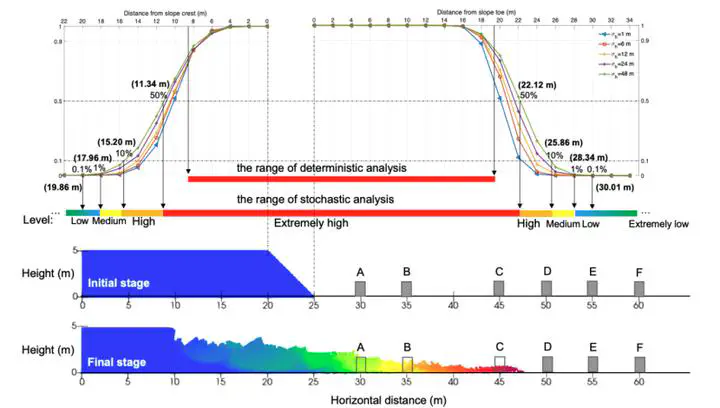
Landslides pose significant threats to infrastructure, human safety, and the environment, especially in regions characterized by steep terrain and unstable soil conditions. Traditional methods of assessing landslide hazards often rely on simplified models that may not fully capture the complex interactions and uncertainties inherent in geotechnical systems. The proposed research aims to develop a stochastic hazard assessment framework for landslides, utilizing large deformation analysis to model the complex soil behaviors and deformation mechanisms under various loading conditions. By incorporating a stochastic approach, this study will account for uncertainties in soil properties and external factors, providing a more robust and comprehensive assessment of landslide risks. -problem statement: The accurate prediction of landslides is hindered by uncertainties associated with soil properties, environmental factors, and complex interactions within slope systems. Current deterministic approaches often fail to adequately capture the nonlinear and large-scale deformations that occur during landslides. This results in either overly conservative or insufficiently predictive hazard assessments. Large deformation analysis provides an advanced modeling framework that can capture significant changes in soil behavior over time, including the development of shear zones and large-scale displacements. A stochastic approach combined with LDA can provide a more realistic representation of the uncertainties and mechanisms involved in landslide events, leading to improved hazard assessments. -Objectives -To develop a stochastic hazard assessment framework for landslides that incorporates large deformation analysis to capture complex soil deformation behaviors. -To identify key factors contributing to landslide susceptibility and quantify their uncertainties using probabilistic approaches. -To create detailed probabilistic hazard maps that reflect the spatial variability and uncertainties in landslide-prone regions. -To provide recommendations for landslide risk management and mitigation based on the results of the stochastic hazard assessmeTo enhance risk assessment and decision-making processes in geotechnical engineering by combining uncertainty quantification with data-driven insights. -The proposed research will span over three years with a budget allocated for equipment, personnel, and field testing. A detailed budget breakdown and timeline will be provided upon request.
References:
- Jiang, S. H., Li, J. P., Ma, G. T., & Rezania, M. (2024). Probabilistic assessment of 3D slope failures in spatially variable soils by cooperative stochastic material point method. Computers and Geotechnics, 172, 106413. ref
- Jiang, S. H., Li, J. P., Ma, G., Rezania, M., & Huang, J. (2024). Stochastic hazard assessment framework of landslide blocking river by depth-integrated continuum method and random field theory. Landslides, 1-19. ref
- 李剑平, 蒋水华, 黄发明, & 黄劲松. (2024). 考虑渗透系数空间变异性的降雨作用下边坡大变形破坏特征. 应用基础与工程科学学报, 32(1), 72-84. ref