AI-Enhanced Granular Modeling of Rockburst Failures with Anisotropic Joints
Abstract
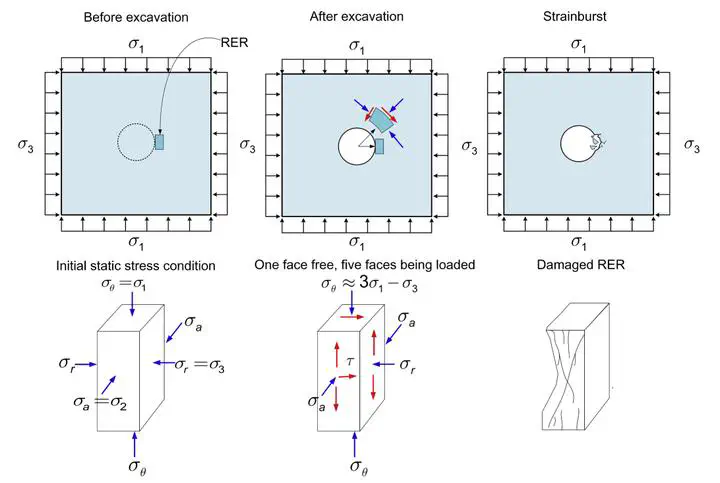
Rockbursts represent a significant hazard in deep underground excavation, such as mining and tunneling, due to the sudden release of stored elastic energy from rock masses. The complexity of rockburst phenomena is further exacerbated by the presence of anisotropic joints, which influence stress distribution, energy release, and failure patterns. Traditional modeling methods struggle to capture the intricate behavior of these joints, leading to uncertainties in predicting rockburst risks. This proposal introduces a novel approach by integrating artificial intelligence (AI) with granular modeling techniques to simulate rockburst events. AI algorithms will be employed to optimize model parameters, detect patterns in joint behavior, and enhance the prediction of rockburst occurrences. The research will focus on understanding the impact of joint anisotropy on rockburst initiation and propagation, with the aim of providing a robust framework for risk assessment and mitigation. -problem_statement: Geotechnical engineering problems are frequently influenced by uncertainties that arise from the heterogeneity of soils, complex interactions between geological materials, and limitations in data collection. Current deterministic approaches often overlook or inadequately represent this uncertainty, leading to potentially inaccurate predictions of soil behavior, foundation performance, and slope stability. As geotechnical projects become more ambitious, there is a growing need to develop tools that can effectively account for these uncertainties to ensure safety, efficiency, and reliability in geotechnical design and construction. -Objectives -To develop an AI-enhanced granular modeling framework for rockburst analysis, capable of simulating the effects of anisotropic joint properties on rock mass behavior. -To utilize AI algorithms for optimizing model parameters, identifying critical factors, and improving the accuracy of rockburst prediction in jointed rock masses. -To investigate the influence of joint anisotropy (orientation, spacing, and mechanical properties) on the initiation and propagation of rockbursts under different stress conditions. -To generate AI-driven insights into rockburst risk assessment and mitigation, including recommendations for support design and excavation practices. -To validate the proposed AI-enhanced modeling approach through case studies and comparison with documented rockburst incidents. -The proposed research will span over three years with a budget allocated for equipment, personnel, and field testing. A detailed budget breakdown and timeline will be provided upon request.